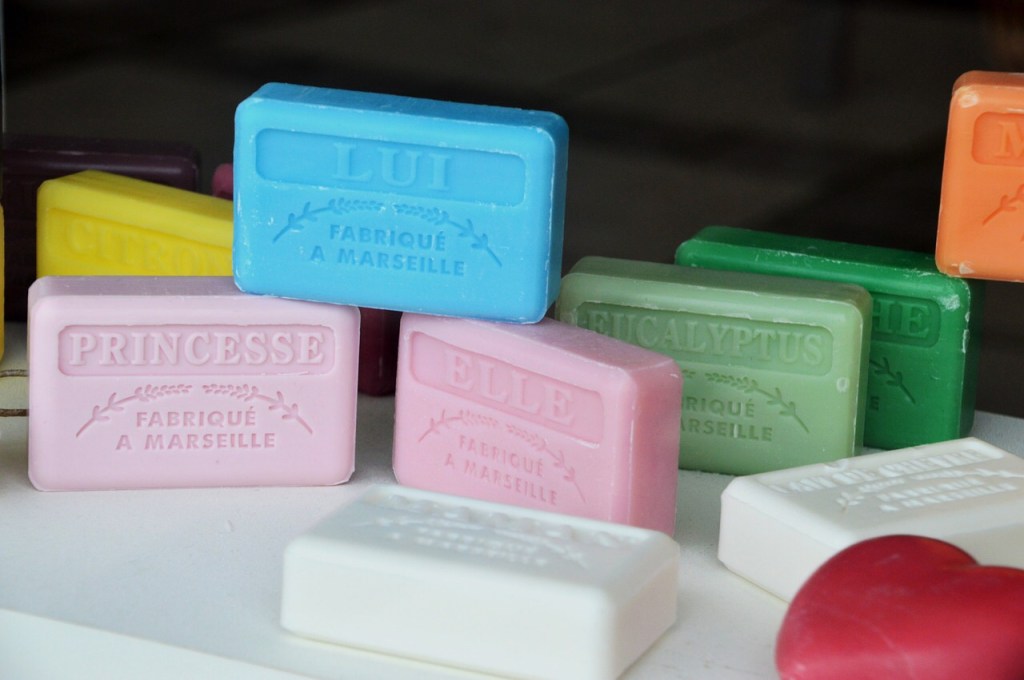
Marseille is a city in the south of France that is famous for its traditional hard soaps that have been made there since the 1600’s. They are made with many different flavours and made a big come back in the 80’s when people decided to search for products which were more environmentally friendly and kind to their skin.

The soaps were originally made from a vegetable oil base and then later an olive oil base was introduced. They are generally made with natural ingredients. In 1688 Louis IV passed the Order Of Colbert authorizing the use of Savon de Marseille label for olive oil soaps. The order states that the soap comprises of 72% of olive oil. 132 soap makers were established by the year 1924, but by 1950 there was a sudden increase of petrol-based soaps and the olive oil soaps became dated. At present there are only five savonneries who can claim the genuine title Soap de Marseille and have the authentic mark to prove it. It is identified by a small square soap block with the Union des Professionals du Savon de Marseille clearly indicated on the packaging. Anything else is deemed as a counterfeit.
Marius Fabre is a longstanding company that produces Marseille soap. Such companies are otherwise known as “savonneries.” Watch the video below to learn more about traditional Marseille soap.
Here is a list of vocabulary related to Marseille soap:
Marseille soap = Savon de Marseille
Soap making factory = Savonnerie
Ecologic = écologique
Biodegradable = Biodégradable
Without parabens (solvants) = Sans solvent
Without artificial colours = Sans colorant
Black soap = Savon noir
Flavour(ed) = Parfum(ée)
Olive oil = l’huile d’olive
Shea butter = Au beurre de karité
Bitter almond = à l’Amande amère
Heather honey = Au miel de bruyère
Cherry flower = Fleur de cerisier
Violet = à la Violette
Orange peels = Écorces d’orange
Orange blossom = Fleur d’orange
Apple blossom = Fleur de pommier
Cinnamon = Cannelle
Honeysuckle = Chèvrefeuille
Lavender = à la Lavande
Brasil nut = Noix du Brésil
Coconut = Noix de Coco
Crushed Rosemary = Romarin broyé
Crushed lemon = Citron broyé
Goat milk = Lait du chevre
 Magnifique Lifestyle